
Most Make.com vs Zapier comparison articles you will find in 2026 are written by one of the two platforms themselves. Make.com says Make wins. Zapier says Zapier wins. Neither is useful when you are trying to decide where to build your agency’s automation infrastructure.
This guide gives you the unbiased comparison. Make.com vs Zapier tested specifically against agency workflows: GoHighLevel integrations, multi-client scenario management, cost at scale, debugging speed, and the AI automation capabilities that matter for agencies building client systems in 2026.
The verdict is not the same for every agency. Which platform wins depends on what you are building. This guide tells you exactly which one is right for your specific situation.
Table of Contents
Make.com vs Zapier: The Core Difference in 2026
Before comparing features, understand the fundamental architectural difference between these two platforms.
Zapier is often the tool of choice if you are new to automation, but building in restricted, predefined ways can quickly lead to frustration. Make takes a visual-first approach to workflow automation, letting any team with advanced automation needs build fast without breaking clients’ trust. Sympana
In practical terms for agencies:
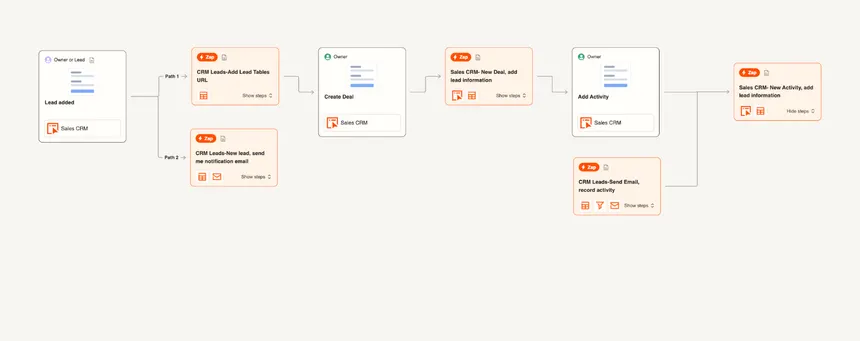
Zapier is a linear, step-by-step automation builder. You create a trigger, add actions in sequence, and the workflow runs from top to bottom. It is the fastest platform to learn, has the widest app integration library, and is built for simplicity first.
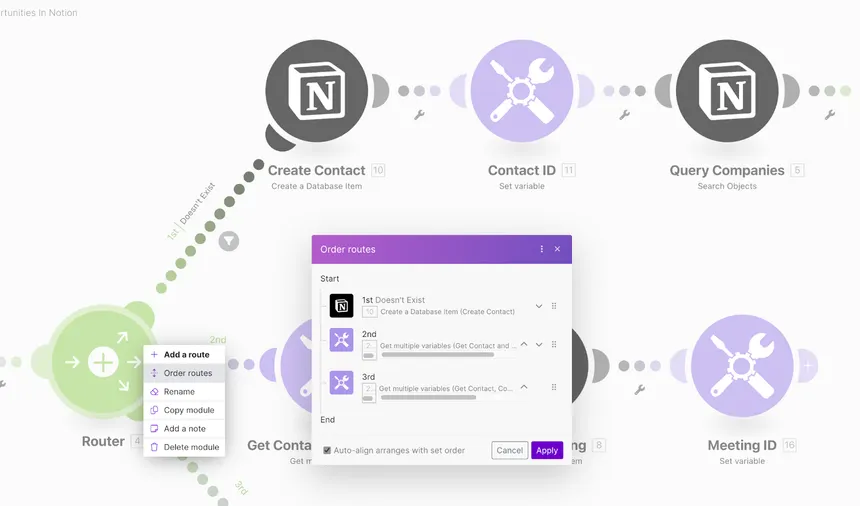
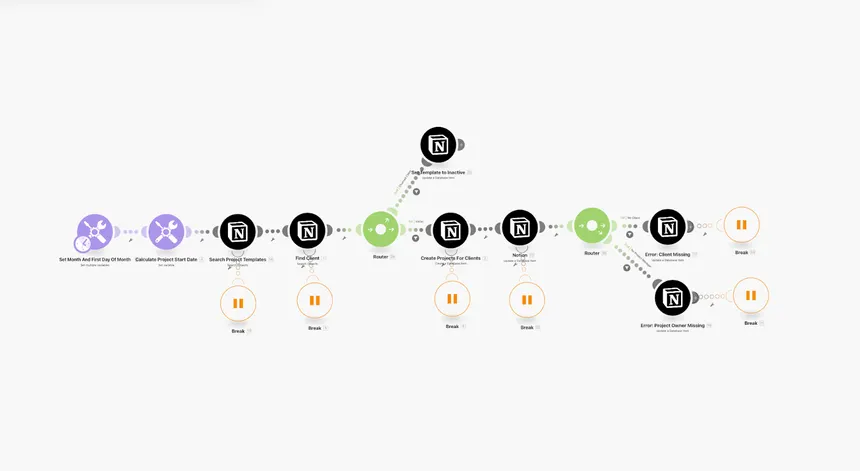
Make.com is a visual canvas where you build scenarios by connecting modules in any direction, with branching paths, loops, filters, and data transformers displayed as a visual flowchart. It is more powerful for complex logic, more cost-efficient at scale, and more controllable when things break.
As one automation expert summarized: “Zapier when you need it done today, Make.com when you need it done right.” Gohighlevel
That quote captures the real trade-off better than any feature matrix.
Make.com vs Zapier Pricing: The Real Agency Cost Comparison
This is where the comparison gets decisive for most agencies.
Make.com Pricing (2026):
| Plan | Annual Price | Credits Per Month |
|---|---|---|
| Free | $0 | 1,000 |
| Core | $9/month | 10,000 |
| Pro | $16/month | 10,000 + priority execution |
| Teams | $29/month | 10,000 + multi-user |
Additional credits: $9 per 10,000 on any paid plan.
Zapier Pricing (2026):
| Plan | Annual Price | Tasks Per Month |
|---|---|---|
| Free | $0 | 100 |
| Starter | $19.99/month | 750 |
| Professional | $49/month | 2,000 |
| Team | $103.50/month | 2,000 shared |
The real cost comparison at agency scale:
A team running 20,000 tasks per month on Zapier’s Team plan pays $299 to $400 per month. The same workload on Make.com costs $34 per month. Simular
That is not a small difference. That is an 88 percent cost reduction for identical automation volume.
For non-technical teams that have hit Zapier’s pricing or logic limits, Make.com delivers 60 to 80 percent cost reduction at the same volume. Simular
Why Zapier costs more at scale:
Zapier bills per task, meaning per successful action completed. A 5-step Zap processing 1,000 leads costs 5,000 tasks. On Zapier Professional at 2,000 tasks per month, you hit the ceiling at 400 leads processed through that single workflow.
Make.com bills per module execution. The same 5-module scenario processing 1,000 leads costs 5,000 credits. On Make Core at 10,000 credits, you process 2,000 leads through that workflow before hitting the ceiling.
Same price tier. Make.com handles 5 times the volume.
Important caveat: Make’s credit-based model can look cheaper upfront, but since every step including triggers, filters, polling, and errors uses credits, costs can increase quickly as workflows grow and require more maintenance. Build your scenarios on the free plan first and watch real credit consumption before estimating your monthly bill. Gohighlevel
Make.com Pricing Is It Worth It for Agencies 2026
Make.com vs Zapier: App Integrations
This is the one area where Zapier has a clear, undisputed advantage.
As of May 2026, Zapier lists 9,000 plus app connections. Make.com lists 3,000 plus apps. Leadlock
That gap matters in one specific scenario: when a client uses a niche tool that Make.com does not have a native module for. In that case, Zapier likely has a pre-built integration and Make.com requires an HTTP module workaround.
Zapier’s integration strength lies in covering the long tail of applications. If a tool has an API, there is a good chance Zapier has integrated it. However, teams building complex workflows often encounter limitations in what each integration can accomplish. Sympana
Make.com generally provides roughly double the number of preset actions per app compared to Zapier. Make lets you automate more types of app actions. For instance, Zapier supports only 25 actions in Xero while Make supports 84, including searches. Sympana
For agency GoHighLevel work specifically:
Both platforms have native GoHighLevel modules covering contact creation, updates, opportunity management, campaign enrollment, and event watching. For GHL integrations, the integration depth is comparable on both platforms. Neither has a meaningful advantage for the workflows agencies build most frequently.
Make.com vs Zapier: Workflow Complexity
This is where the platforms diverge most significantly for agency use cases.
Simple Workflows (2 to 3 steps, linear)
Winner: Zapier
85 percent of non-technical users report successfully building their first Zapier automation within 15 minutes, compared to 35 percent for Make.com. Gohighlevel
For simple trigger-action automations, Zapier’s linear builder is faster to configure, easier to hand off to a non-technical client, and requires no learning curve. If you need to connect a Facebook Lead Ad to a CRM contact creation, Zapier gets it done in 10 minutes.
Complex Workflows (4 or more steps, branching, loops)
Winner: Make.com
Make approaches automation like you are building a flowchart for a reasoning engine. You literally see the entire decision tree on one visual canvas. This god-mode view becomes critical when debugging why your AI prompt returned unexpected output at 2 AM. Automize
For agency workflows with conditional routing, data transformation, iterator loops, or multi-path logic, Make.com’s visual canvas is significantly more capable and easier to debug than Zapier’s linear structure.
As workflows grow more complex, Zapier users start hitting limits in terms of pricing and how messy things get with too many Zaps stacked on top of each other. Voiceai
Error Handling
Winner: Make.com by a significant margin
Make.com offers professional-grade error handling that lets you specify exactly what happens when things break. You can configure it to wait five minutes and retry, ignore specific error types while flagging others, or send an alert only after three consecutive failures. This granular control means your AI agent can gracefully handle temporary API issues without losing critical data. Automize
For agencies managing production client automations where a failed scenario means a lead is lost or a workflow stalls, Make.com’s error handling is a genuine operational advantage over Zapier’s more basic approach.
Make.com vs Zapier for GoHighLevel Integrations
This is the most relevant comparison for agencies running GHL client accounts.
Both platforms support:
- Contact creation and updates in GHL
- Opportunity creation and stage changes
- Campaign enrollment and removal
- Tag management
- Calendar event creation
- Webhook triggers from GHL events
Where Make.com wins for GHL agencies:
Complex lead routing scenarios with multiple conditional paths are significantly easier to build and maintain on Make.com’s visual canvas. When a scenario has 6 or more modules with branching logic based on lead source, budget, or service interest, Make.com’s visual canvas makes the logic readable at a glance. The same scenario in Zapier becomes a stack of linear steps that is difficult to audit and debug.
Make.com’s execution logs show exactly which module in a scenario failed, what data it received, and what it tried to output. For agencies debugging why a client’s lead did not enter the correct GHL pipeline, this granularity saves significant time.
Where Zapier wins for GHL agencies:
If you need to connect GHL to a niche tool your client uses that Make.com does not natively support, Zapier’s broader integration library is more likely to have a pre-built module. For simple, low-volume GHL trigger-action workflows where a client wants to manage their own automations without technical help, Zapier’s simpler interface is easier to hand off.
Make.com GoHighLevel Integration Complete Guide 2026
Make.com vs Zapier for AI Automation in 2026
Both platforms added significant AI capabilities in 2025 and 2026. The approaches differ meaningfully.
Zapier AI (2026):
Zapier is an AI orchestration platform that lets agents act on 9,000 plus connected apps directly through chatbots, coding tools, or terminals without designing workflows in advance. Zapier Copilot lets you describe what you want in plain English and builds the Zap for you. Gohighlevel
Zapier’s AI advantage is accessibility: non-technical users can describe an automation in plain language and get a working Zap. For agencies onboarding clients to manage their own simple automations, this lowers the adoption barrier.
Make.com AI (2026):
Make supports 3,000 plus app integrations of which 560 are AI apps, and manages all automation and AI agents in a single visual landscape offering a glass-box view into complex logic. Sympana
Make.com is superior for complex AI automation. It offers better conditional logic, error handling, and data manipulation capabilities. You can build sophisticated workflows that make decisions based on AI responses and handle multiple scenarios. Automize
For agencies building AI-augmented client workflows, such as lead scoring with OpenAI before CRM entry, sentiment analysis on inbound messages, or AI-generated follow-up personalization based on CRM data, Make.com’s visual canvas makes the AI logic transparent and debuggable in ways Zapier’s linear structure does not.
Make.com AI limitation: Make’s AI cobuilder Maia is still in early access. Until it launches fully, you build from scratch or from a template without conversational AI assistance, unlike Zapier Copilot which is fully available. Gohighlevel
Real Agency Scenario: Which Platform Wins
Scenario 1: Facebook Lead Ads to GHL Contact to SMS Sequence
3-step linear workflow. Low volume. Client wants to manage it themselves after setup.
Winner: Zapier. Faster setup, simpler interface for client handoff. Cost difference is negligible at low volume.
Scenario 2: Multi-Source Lead Routing with AI Scoring
Facebook, Google, and Typeform leads arrive. Each is scored by an AI model. High-intent leads go to priority GHL pipeline with immediate SMS. Low-intent leads enter drip sequence. Scoring failures get flagged to Slack.
Winner: Make.com. The branching logic, AI module integration, error handling, and visual canvas make this scenario buildable and maintainable in Make.com. In Zapier, this becomes 4 to 5 separate Zaps at significantly higher monthly cost.
Scenario 3: Client GHL Data to Weekly Reporting Sheet
Pull GHL pipeline data, calculate conversion rates, push to Google Sheets, send summary email every Monday.
Winner: Make.com. Iterator loops for processing multiple pipeline records, data aggregators for calculations, and scheduling flexibility make this scenario significantly cleaner in Make.com than Zapier.
Scenario 4: Niche CRM Not Supported by Make.com to GHL Contact Sync
Client uses a specialized industry CRM that Make.com does not natively support.
Winner: Zapier. Broader integration library makes this a 10-minute setup instead of an HTTP module workaround.
Make.com vs Zapier: Head-to-Head Verdict for Agencies
| Factor | Make.com | Zapier | Agency Winner |
|---|---|---|---|
| Pricing at scale | $9 to $29/month | $49 to $103/month | Make.com |
| App integrations | 3,000+ | 9,000+ | Zapier |
| Complex workflow logic | Excellent | Limited | Make.com |
| Simple workflow setup | Moderate | Excellent | Zapier |
| Error handling | Professional grade | Basic | Make.com |
| AI automation depth | Superior | Accessible | Make.com |
| Learning curve | Steeper | Gentler | Zapier |
| GoHighLevel integration | Full module | Full module | Tie |
| Debugging speed | Fast with logs | Slower | Make.com |
| Client handoff ease | Harder | Easier | Zapier |
Overall agency verdict: Make.com wins for most agency automation work in 2026.
The cost advantage at scale is decisive. The visual canvas makes complex client workflows buildable and auditable. The error handling protects production scenarios from silent failures. For agencies managing 5 or more client automation workflows simultaneously, the operational and financial advantages of Make.com compound significantly over time.
The exception: If your agency primarily builds simple 2 to 3 step integrations for non-technical clients who manage their own automations, and your clients regularly use niche tools outside Make.com’s integration library, Zapier’s broader app coverage and simpler interface may serve you better.
The smartest agencies in 2026 use both strategically. Zapier for simple triggers and time-sensitive client needs. Make.com for complex workflows, data transformations, and high-volume processes. Gohighlevel
FAQ
Q: Is Make.com better than Zapier for agencies?
A: For most agency use cases in 2026, yes. Make.com delivers 60 to 80 percent lower costs at equivalent automation volume, superior complex workflow logic, professional error handling, and a visual canvas that makes multi-step client scenarios easier to build and audit. Zapier wins for simple automations, broader app coverage, and easier client handoff.
Q: How much cheaper is Make.com than Zapier?
A: At scale, significantly cheaper. A team running 20,000 automation tasks per month pays $299 to $400 per month on Zapier versus approximately $34 per month on Make.com for the same volume. At lower volumes the difference narrows but Make.com consistently costs less per automation action.
Q: Does Make.com integrate with GoHighLevel?
A: Yes. Make.com has a native GoHighLevel module library covering contact management, opportunity tracking, campaign enrollment, tag management, and event triggers. For agencies using GHL as their primary client CRM, Make.com’s GHL integration is full-featured and production-ready.
Q: Which is easier to learn, Make.com or Zapier?
A: Zapier is significantly easier to learn. 85 percent of non-technical users build their first working automation within 15 minutes on Zapier, compared to 35 percent on Make.com. Make.com’s visual canvas is more powerful but has a steeper learning curve that typically requires 10 to 20 hours of practice before building confidently.
Q: Can I use both Make.com and Zapier together?
A: Yes, and many agencies do. A common approach is using Zapier for simple client-facing automations that clients manage themselves, and Make.com for complex backend agency workflows where control and cost efficiency matter more than simplicity.
Q: Which platform is better for AI automation workflows?
A: Make.com wins for complex AI automation requiring conditional logic, data transformation, and error handling around AI model outputs. Zapier wins for simple AI-assisted automations where non-technical users want to describe what they need in plain language and get a working automation quickly.
Final Verdict on Make.com vs Zapier for Agencies
Make.com is the right primary automation platform for most agencies building client systems in 2026. The cost advantage at scale, superior complex workflow capability, and professional error handling make it the stronger operational choice for agencies managing multiple client automation scenarios simultaneously.
Zapier earns a place in your agency stack for specific scenarios: niche app integrations Make.com does not support, simple automations for non-technical clients to manage independently, and situations where setup speed matters more than long-term cost efficiency.
The agencies operating most efficiently in 2026 are not choosing one or the other. They are using Make.com as their primary platform and reaching for Zapier only when Make.com’s integration library falls short.
Explore more automation guides, GoHighLevel tutorials, and agency tool comparisons at makeJUMP Articles, covering the platforms and systems that actually help agencies scale in 2026.

Jaber Rayhan has 6+ years of hands-on experience creating marketing systems, sales pipelines, and automation workflows for service businesses in the USA, UK, Europe and the Middle East, as a CRM automation specialist and GoHighLevel expert. He is a CRM Expert and Manager at Sales Compass where he creates and implements end-to-end GHL automation solutions for real clients, such as CRM architecture, funnel design, appointment workflows, and lead qualification systems. He is also the founder of makeJUMP, a digital agency that specializes in CRM automation and GoHighLevel builds. All makeJUMP Articles are based on first-hand experience with implementation, not just research.